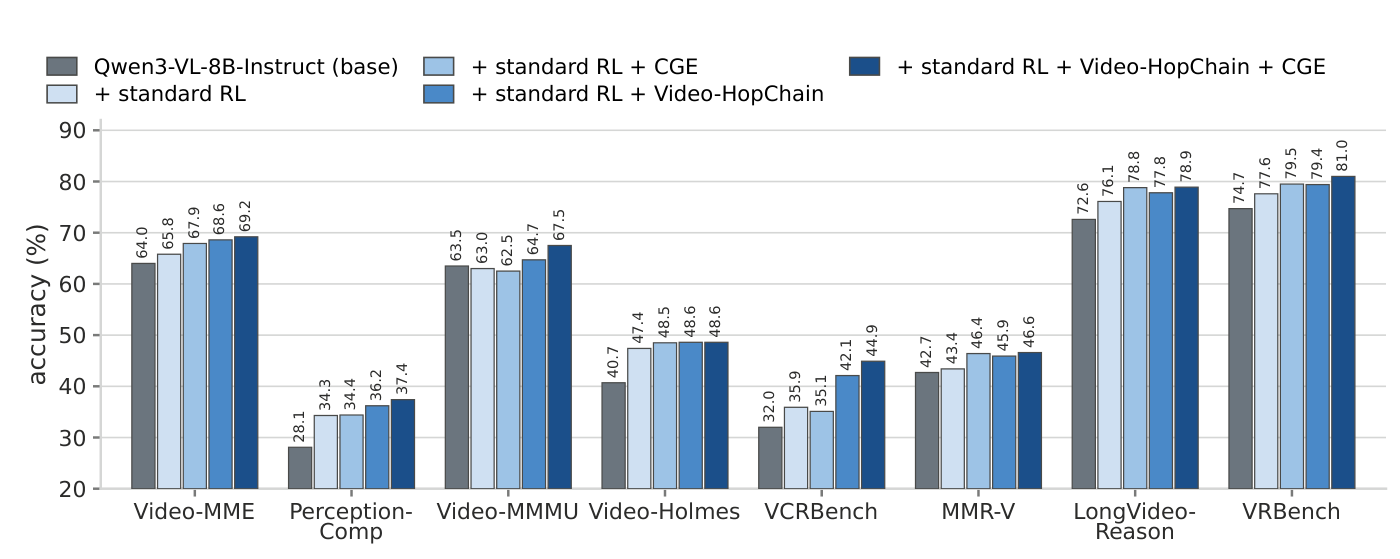
HopChain has shown on still images that multi-hop data synthesis improves vision-language reasoning, because long chain-of-thought reasoning exposes errors that compound across steps, while most data used for reinforcement learning with verifiable rewards (RLVR) rarely demands a chain of visual evidence, so these weaknesses are likely to stay unexposed. We observe the same problem in video, where this framework has not yet been explored. We therefore build Video-HopChain, a dataset of 22,550 multi-hop video questions over 13,378 videos, together with a held-out benchmark of 1,000 questions. Each question chains three to six yes/no questions about moments in one video, and each of them yields one of two integers depending on its answer. The final answer is the sum of these integers, so an exact match on that sum gives the verifiable reward that RLVR needs.
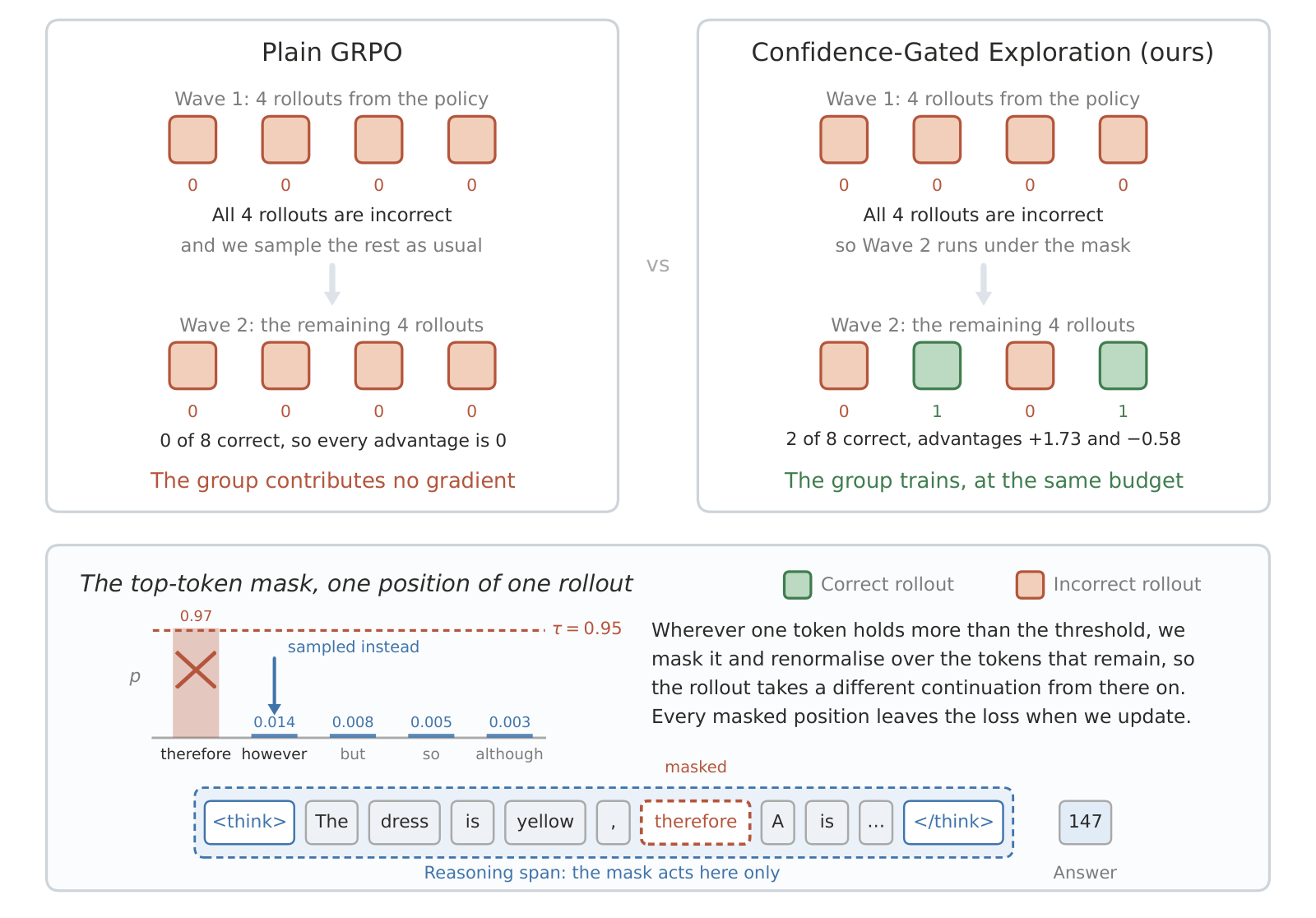
We first train Qwen3-VL-8B with GRPO on a standard video dataset, and a second stage on Video-HopChain then raises the mean over eight video understanding and reasoning benchmarks from 55.4 to 57.9 and improves every one of them. Training on such a dataset, however, also exposes a known limitation of GRPO: its learning signal comes from the reward variance within a group, so hard questions whose rollouts are all incorrect and easy questions whose rollouts are all correct both leave the group with no gradient. To recover these groups at the same compute budget, we introduce Confidence-Gated Exploration (CGE). With 8 rollouts per question, CGE samples the first 4 rollouts as usual. If these 4 rollouts are either all correct or all incorrect, it then samples the last 4 rollouts with the policy's most confident token masked inside the reasoning span, and it removes the masked positions from the loss while all 8 rollouts enter the advantage. With CGE, the mean rises further to 59.3. We release the dataset, the checkpoint, the data generation code, and the training code.
Every question chains three to six yes/no hops, and each hop asks about a different moment of the same video. Each hop carries two integers, of which the first counts when the answer to the hop is yes and the second when the answer is no. The model adds the integers of all hops, and that sum is the answer. We resample the integers of a question until every combination of hop answers gives a different sum, so one wrong hop always changes the total, and an exact match on one number gives a verifiable reward.
Training questions
22,550
Videos
13,378
Held-out benchmark
1,000
Hops per question
3–6
GRPO learns from the reward variance within a group of rollouts, so a group whose rollouts are all correct or all incorrect gives no gradient. CGE splits the 8 rollouts of a question into two waves of 4. If the first wave is all correct or all incorrect, CGE samples the second wave with the policy's top token masked wherever its probability exceeds τ = 0.95 inside the reasoning span. Each masked position leaves the loss, and all 8 rollouts enter the group advantage, so the group can train at the same compute budget.
A second stage on Video-HopChain raises the mean and improves every one of the eight benchmarks. Enabling CGE on top of that dataset raises the mean again, and the combined run holds the best value of every column. The last column is the accuracy on the 1,000 held-out Video-HopChain questions.
| Model | VMME | PComp | VMMMU | Holmes | VCR | MMR-V | LVR | VRB | Mean | Δ vs base | Δ vs standard RL | In-domain |
|---|---|---|---|---|---|---|---|---|---|---|---|---|
| Qwen3-VL-8B-Instruct | 64.0 | 28.1 | 63.5 | 40.7 | 32.0 | 42.7 | 72.6 | 74.7 | 52.3 | – | – | 13.4 |
| + standard RL | 65.8 +1.8 | 34.3 +6.2 | 63.0 −0.5 | 47.4 +6.7 | 35.9 +3.9 | 43.4 +0.7 | 76.1 +3.5 | 77.6 +2.9 | 55.4 | +3.1 | – | 13.4 ±0.0 |
| + standard RL + CGE | 67.9 +3.9 | 34.4 +6.3 | 62.5 −1.0 | 48.5 +7.8 | 35.1 +3.1 | 46.4 +3.7 | 78.8 +6.2 | 79.5 +4.8 | 56.6 | +4.3 | +1.2 | 16.4 +3.0 |
| + standard RL + Video-HopChain | 68.6 +4.6 | 36.2 +8.1 | 64.7 +1.2 | 48.6 +7.9 | 42.1 +10.1 | 45.9 +3.2 | 77.8 +5.2 | 79.4 +4.7 | 57.9 | +5.6 | +2.5 | 21.2 +7.8 |
| + standard RL + Video-HopChain + CGE | 69.2 +5.2 | 37.4 +9.3 | 67.5 +4.0 | 48.6 +7.9 | 44.9 +12.9 | 46.6 +3.9 | 78.9 +6.3 | 81.0 +6.3 | 59.3 | +7.0 | +3.9 | 23.2 +9.8 |
Benchmarks: Video-MME, PerceptionComp, Video-MMMU, Video-Holmes, VCRBench (multiple-choice subset), MMR-V, LongVideo-Reason and VRBench. The small number under each score is the change against the base model, green for a gain and red for a drop. Δ vs standard RL compares the mean against the run after the first stage. The best value of each column is bold on a green cell, and the last row is the released model.
V-HopChain gives the best value on most of these benchmarks, ties with Conan on VRBench, and comes a close second on Video-Holmes and on LongVideo-Reason, where OneThinker leads. OneThinker is the one model of this set that starts from the same base model as ours. We compare released systems rather than recipes, because these models differ in base model, training data and compute.
| Model | Base | VMME | PComp | VMMMU | Holmes | VCR | MMR-V | LVR | VRB | Reported | V-HopChain ahead | Mean Δ (shared) |
|---|---|---|---|---|---|---|---|---|---|---|---|---|
| base model | ||||||||||||
| Qwen3-VL-8B-Instruct† | – | 64.0 | 28.1 | 63.5 | 40.7 | 32.0 | 42.7 | 72.6 | 74.7 | 8 / 8 | 8 / 8 | +7.0 |
| open-source video reasoning models | ||||||||||||
| Video-R1 | Qwen2.5-VL-7B | 61.4 | 26.3 | 52.4 | 36.5 | 48.0* | 36.3* | 68.1 | 69.5* | 8 / 8 | 7 / 8 | +9.5 |
| VideoChat-R1 | Qwen2.5-VL-7B | 60.0 | 28.6 | 46.4 | 33.0 | 48.2* | 36.1* | 67.2 | 61.5* | 8 / 8 | 7 / 8 | +11.6 |
| VideoRFT | Qwen2.5-VL-7B | 59.8 | – | 51.1 | – | – | – | – | – | 2 / 8 | 2 / 2 | +12.9 |
| Video-RTS | Qwen2.5-VL-7B | 63.0 | – | 52.7 | 40.7 | – | – | – | – | 3 / 8 | 3 / 3 | +9.6 |
| Video-KTR | Qwen2.5-VL-7B | 62.5 | – | 53.1 | 42.7 | – | – | – | – | 3 / 8 | 3 / 3 | +9.0 |
| Video-Thinker | Qwen2.5-VL-7B | – | – | – | 43.2 | – | – | – | 80.7 | 2 / 8 | 2 / 2 | +2.8 |
| Video-o3 | Qwen2.5-VL-7B | 66.5 | – | 51.7 | 46.5 | – | 44.7 | – | – | 4 / 8 | 4 / 4 | +5.6 |
| Conan | Qwen2.5-VL-7B | – | – | – | 44.6 | 51.0* | 42.7 | 72.8 | 81.0 | 5 / 8 | 3 / 5 (1 tie) | +1.6 |
| LongVILA-R1 | LongVILA-7B | 65.1 | – | 51.0 | – | – | – | 72.0 | – | 3 / 8 | 3 / 3 | +9.2 |
| OneThinker | Qwen3-VL-8B | 66.5 | – | 66.2 | 48.7 | – | – | 79.2 | – | 4 / 8 | 2 / 4 | +0.9 |
| V-HopChain (ours) | Qwen3-VL-8B | 69.2 | 37.4 | 67.5 | 48.6 | 44.9 | 46.6 | 78.9 | 81.0 | 8 / 8 | – | – |
A dash marks an unreported number. The best value of each column is bold on a green cell and the second best is underlined. * A value taken from Conan. † A result that we reproduce under our own setting. Reported counts the benchmarks a model reports. V-HopChain ahead counts the reported benchmarks on which V-HopChain scores higher, and Mean Δ (shared) is the mean gap of V-HopChain over those same benchmarks.
@misc{nguyenquang2026videohopchain,
  title         = {Video-HopChain: Multi-Hop Questions and Confidence-Gated Exploration for Video Reasoning Models},
  author        = {Nguyen Quang, Trung and Dong, Yuhao and Sun, Shuo and Liu, Shuai and Tian, Shulin and Yap, Kim-Hui and Liu, Ziwei},
  year          = {2026},
  eprint        = {2609.25773},
  archivePrefix = {arXiv},
  primaryClass  = {cs.CV},
  url           = {https://arxiv.org/abs/2609.25773}
}